
We’re thrilled to announce a lush new dual timeline suspense for fans of thrillers and historical suspense, from writer Jane Holland.
SECRETS OF SYCAMORE HALL is set in the Victorian era and the 1970s.
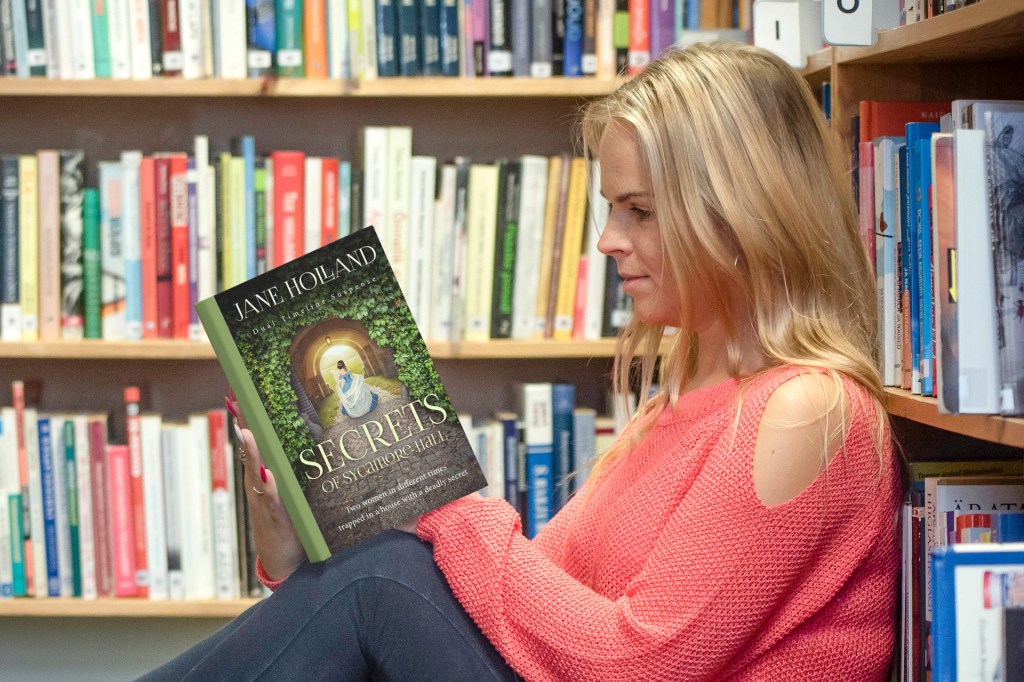
Born almost a hundred years apart on opposite sides of the Atlantic, Arabella and Jessie lead wildly different lives.
In 1880s Cornwall, Arabella is kept locked up by a cruel elder brother, her every thought and movement controlled. Meanwhile, in 1970s New York, Jessie defies her conservative family to campaign for women’s liberation.
In the beautiful but sinister Sycamore Hall on Cornwall’s Bodmin Moor, these two young women are about to be drawn together in different times to meet Nicholas Fitton, solve a deadly puzzle… and change all their lives forever.
A gripping and atmospheric dual timeline suspense from the popular author of Girl Number One, The Manor House and The Silver Ring. Buy now on Amazon UK or Amazon US. Available in ebook, paperback, or free to read via Kindle Unlimited.
Q & A with author Jane Holland
We love your new book! But this one is a little different, isn’t it? You ordinarily write dual timeline historicals with one historical narrative and one present day narrative, but Secrets of Sycamore Hall is set in the Victorian era and the 1970s. Why did you choose to write two historical narratives this time?
When I was thinking about the original concept for this story, I intended a modern day narrative combined with a 1970s storyline… but I couldn’t get it to work convincingly enough, probably because the backstory was so… well, complex and bizarre, that I felt it could only feel truly authentic if I cast it further back in time. But by going back to the Victorian era, I then found the original plot’s timeline too unwieldy, the distance between the two stories was just too great for some elements of the plot to be plausible. So I made a decision to have two historical periods, with no modern day narration at all.
Without wishing to post any spoilers for your very complicated suspense plot, can you say what drew you to this particular concept, given the dark secret at its heart?
I had a key image in my mind when I first came up with this story, which actually never made the final book, and it’s hard to talk about it without giving away the core ‘secret’ of Sycamore Hall, but… it was very much connected to psychic ability and mediumship in particular, to the possibility of life after death, and to the idea of evil as an almost physical presence in a house – and whether any of that could be real, or if it’s just part of our superstitious instincts as human beings, to fear the dark and the unknown, and project our fears onto them. And that’s probably the most I can say about my inspiration for the book without giving too much away…
Do you plan your novels in advance or just start writing from an opening idea or image?
I’m definitely a plotter. I’ve tried winging it in the past with just a few scribbled notes, and it has almost always resulted in either not being able to finish the novel, or taking ages to finish and the whole thing being an absolute mess and needing many drafts to ‘fix’ it. I recently heard an author saying she doesn’t plot her novels but goes through four or five drafts to get it right, and I didn’t say anything but wondered why she didn’t just write out a plan beforehand and stick to it, as she would very likely then not have to labour quite so hard on redrafting! I guess we all have our own way of working, but in the interests of economy of effort, knowing your destination is surely more productive than meandering about in a spirit of creative exploration and hoping to get there eventually.
Anyway, yes, I plan my books. Though not within an inch of their lives – I also once heard a very well-known and successful novelist admitting to writing a ‘treatment’ before starting any novel, this document being maybe a tenth of the novel’s length, so 10,000 words long if the novel would be 100,000 words (a fairly standard length for commercial fiction). To my mind, that would be exhausting and ludicrous, but of course it must work for him. I write a 3-5 page synopsis (what happens to whom and why, presented in a fairly flat, linear fashion and without frills) as a selling document if required and, for myself, a chapter breakdown, though this is often more detailed for the start of the novel up to roughly the mid-section crisis, and sometimes I’ll just leave the last third a bit vague, except for the nuts and bolts, eg who the murderer is if it’s a thriller, and what happens to the main characters. And everything in my outline is flexible and negotiable. That way I feel I still have room to manoeuvre creatively while never losing sight of important plot requirements.
What is your usual writing routine?
I dislike routine, and yet often seem to fall into one periodically. Most days, I go out to write, as it’s too tempting at home to check emails, watch videos and fall down online rabbitholes instead of working (though sometimes that is working, as research is part of my job as a novelist, as is networking and book promo). So I choose a cafe with rubbish or no WiFi, and write there for an hour or so. I like to do at least a thousand words at a sitting, and preferably two. Sometimes that also requires me to use dictation software to amp up the word count, then edit it afterwards. (At home rather than in public, of course.) Saves wear and tear on my poor fingers! When I’m up against a deadline, I will increase my working time and word count, sometimes up to 7000 words a day, which is not sustainable for me beyond a week or so. That requires long hours sitting up in bed with a laptray, tapping away furiously…
And what’s next for you?
I’m currently writing another dual timeline set in Brittany, France, after a visit there with my daughter in 2024. We were on a month-long tour of France from coast to coast, and after crossing the Channel we spent about five days in Carnac, walking among the ancient stones and forests there, and swimming in the sea off the gorgeous Brittany coast. It’s a wild and beautiful spot, especially in early summer before all the tourists descend, and there were many fascinating historical facts to learn about the area. In particular, a visit to the local museum and to the megalithic stones’ centre at Carnac gave me a few initial ideas for a novel set partly in World War Two. I’m keeping the storyline under my hat for now, but I’ve got the whole thing planned out and have started work on it already.
Looking forward to it!
Interviewed by Dylan Haynes.
 Thimblerig Books